Unlocking Creativity and Confidence: Benefits of Kids Learning Game Development This Summer
- alittlebloomroom
- May 20
- 5 min read

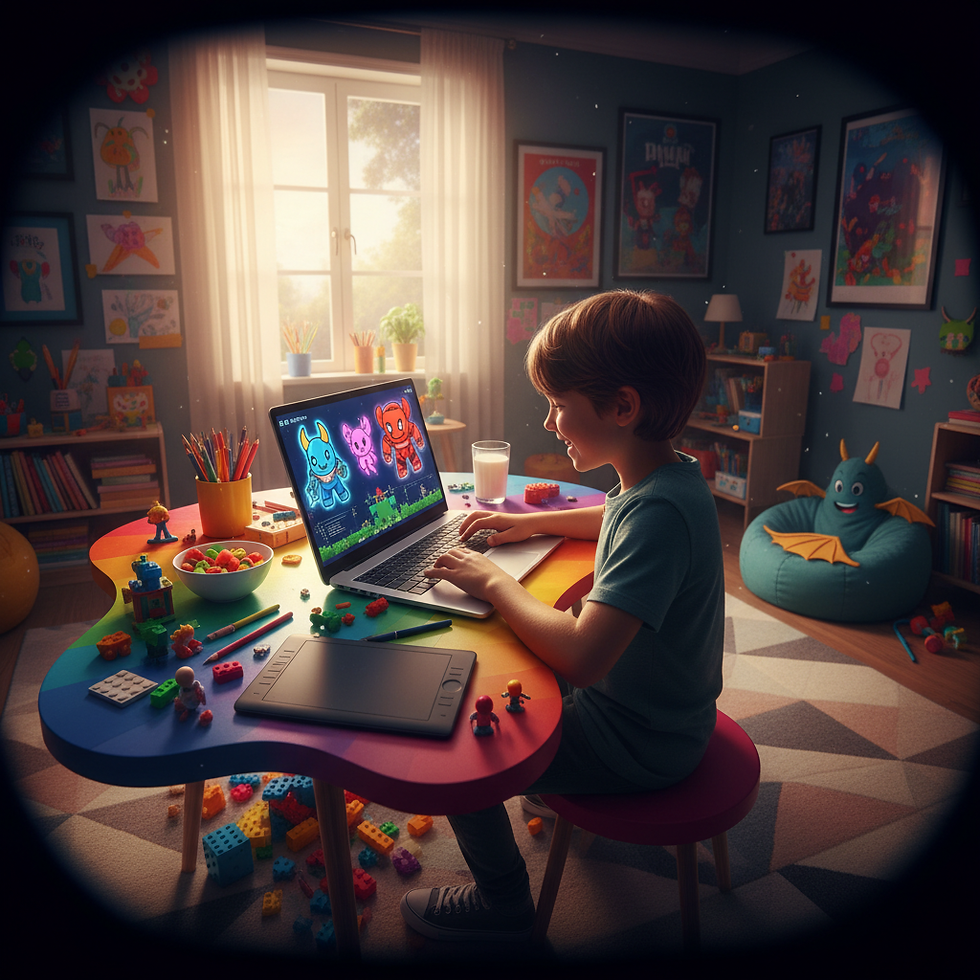
Every parent wants their child to spend the summer doing something meaningful. Something that sticks. While sports camps and art classes have their place, a growing number of families are discovering that learning to build video games might be one of the most powerful things a kid can do before September rolls around.
It sounds like play. It is play. But underneath the fun, something important is happening.
Why Creativity and Confidence Matter More Than Ever
Children today are surrounded by digital experiences, from apps and social media to streaming platforms and games. Most of the time, they are consumers. Game development flips that dynamic entirely: kids become the ones doing the creating.
When a child designs a character, writes the rules of a world, or figures out why their jumping mechanic is not working, they are exercising creative muscles that no worksheet can reach. They are making decisions, taking risks, and building something that did not exist before they sat down.
That shift from consumer to creator does something powerful for a child's confidence. Finishing a game, even a simple one, gives kids concrete proof of what they are capable of. That feeling carries into the classroom, into friendships, and into how they approach challenges throughout their lives.
Research consistently supports this. A 2023 report from the Entertainment Software Association found that 76% of parents believe video games help their children develop key skills. The skills most commonly cited? Problem-solving, creativity, and persistence.
Game Development Builds Real Problem-Solving Skills
Building a game is essentially one long, satisfying puzzle. Kids have to think through how each piece connects. If a character moves too fast, the game breaks. If the score doesn't add up correctly, players get frustrated. Every decision has a consequence, and kids learn to trace cause and effect in a way that feels natural rather than academic.
This kind of thinking, called computational thinking in education circles, is one of the most valuable skills a child can develop. It teaches them to break big problems into smaller steps, spot patterns, and test solutions systematically. These are the same skills used by engineers, designers, doctors, and scientists every day.
Debugging, the process of finding and fixing errors in code, is especially valuable. A child who learns to debug does not panic when something goes wrong. They get curious. They ask: "What changed? What could be causing this?" That mindset is enormously useful far beyond the screen.
Teamwork You Can Actually See
When kids build games together, they quickly learn that everyone's role matters. One child might focus on the visual design while another handles the logic behind the score counter. A third might be the one who keeps testing the game and reporting bugs.
This kind of collaborative work mirrors real creative industries. Game studios, film productions, and software companies all run on teams where different strengths combine. When children experience this at a young age, they learn to listen, to compromise, and to celebrate contributions that aren't their own.
Parents who have enrolled their kids in group game development programs often report a noticeable change in how their children communicate. One mum described her 10-year-old son coming home and explaining, unprompted, how he had to change his idea for a game level because his partner had a better approach. "He was proud of choosing the better idea," she said. "That was new for him."
Rocket Science Summer Classes: What to Expect
Rocket Science offers online summer game development classes designed specifically for children, with programs tailored by age and experience level. Whether your child has never written a line of code or has already been tinkering with beginner tools, there is a track built for where they are right now.
Ages 6–10
Beginners start with visual, block-based coding tools that make game logic easy to grasp without needing to type complex syntax. Kids build simple games while learning the core ideas behind design and interactivity.
Ages 11–13
Intermediate learners move into text-based coding, character animation, and more complex game mechanics. Projects at this level are more ambitious, with students creating multi-level games with custom art and sound.
Ages 14–17
Advanced students work with industry-standard tools, building fully playable games that they can share with friends and family. At this level, the focus shifts toward game design principles, project management, and portfolio-ready work.
All classes are live, instructor-led, and small-group. That means children get real feedback, real encouragement, and real relationships with peers who share their interests. Sessions run across the summer in flexible weekly blocks, so families can fit them around travel, sports, and other commitments.
Success Stories From Past Participants
The proof is in the projects. Past participants have built everything from classic platformers to original puzzle games with hand-drawn art. One 12-year-old girl spent three weeks building a game inspired by her love of marine biology, complete with underwater levels and a storyline about ocean conservation. Her parents said she spent hours after class working on it voluntarily, something she had never done with homework.
Another parent shared that her shy, introverted 9-year-old found his footing during a group project. "He became the one explaining things to others," she said. "His teacher even noticed a change when school started again in September."
These are not isolated stories. Programs that combine game development with structured mentorship consistently report improvements in students' confidence, focus, and enthusiasm for learning. The creative outlet and the tangible result, an actual game you built yourself, creates a sense of ownership that is hard to replicate in a traditional classroom setting.
Tips for Parents: How to Support Your Young Game Developer
You do not need to know anything about coding to support your child through a game development course. Here are a few things that make a real difference:
Ask to see their work. Show genuine interest in what they are building. Ask what the game is about, who the characters are, what problem they solved today. Curiosity from a parent signals that what they are doing matters.
Let them struggle a little. Resist the urge to jump in when they hit a wall. The frustration of debugging is part of the process, and the satisfaction on the other side of it is irreplaceable.
Celebrate the small wins. Getting a character to move, making a sound play at the right moment, fixing a bug they have been chasing for an hour. These feel big to a child. Treat them that way.
Set up a good workspace. A quiet spot with a reliable internet connection and a comfortable setup goes a long way toward helping kids stay focused during live sessions.
Play their game. When they finish something, sit down and play it. Give real feedback. Let them watch you react to something they built. There are few things more motivating for a young creator than an engaged audience.
A Summer That Builds More Than Skills
Game development gives children a rare combination of things: creative freedom, technical challenge, social collaboration, and a finished product they are proud of. Those four elements together create an experience that many kids carry with them long after summer ends.
The children who build games this summer will not all become professional developers. Many will go on to be writers, artists, scientists, or entrepreneurs. But they will all carry something from this experience: the knowledge that they can look at a blank screen, build a world, and make it work.
That is a skill worth giving your child.
A Little Bloom Room Update: We are so excited to share that the Little Bloom Room kids will be taking advantage of this resource this summer! Rollo and Mel will both be jumping into these courses, and we cannot wait to see what they create. We will be sharing updates along the way, so stay tuned!


Comments